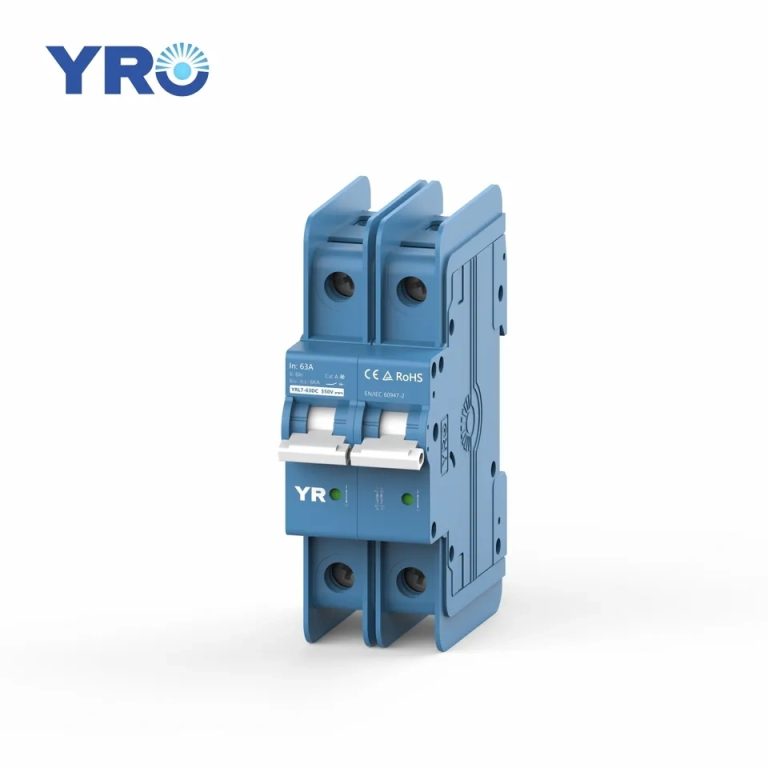







Disyuntores use different tripping characteristics to respond to overcurrent conditions.
B, C and D curves are common instantaneous tripping characteristics for MCBs. These curves define different current ranges for rapid tripping when a circuit experiences a high current.
This guide explains the differences between B, C and D curves, their common applications, and the key factors buyers should consider when selecting a circuit breaker.
What Is a Circuit Breaker Tripping Curve?
Circuit breakers have several curves, including A, B, C, D, and K, but the B, C, and D curves are the most commonly used in daily life and work.
A tripping curve describes a circuit breaker’s response to different currents and its operating time. In simple terms, a tripping curve is a switch that decides when to trip based on the magnitude of the current.
- When the current slightly exceeds the normal range: the circuit breaker does not trip immediately, but may trip after a period of time.
- When the current suddenly becomes very large: if the current reaches the instantaneous tripping condition of the circuit breaker, the circuit breaker trips quickly.
A tripping curve is used to explain approximately when a circuit breaker will operate when the current reaches different magnitudes. This characteristic helps users understand the operating time of a circuit breaker under different current conditions and provides a basis for circuit breaker selection.
At this point, some people may ask: is it not better for a circuit breaker to trip as quickly as possible? Why is there a delay?
In fact, a MCB breaker cannot trip immediately as soon as it detects that the current exceeds the rated value, otherwise many normal devices might fail to start.
For example:
When a motor starts, it usually briefly draws a current larger than its normal operating current. This is a normal starting process. If the circuit breaker trips immediately in response to this brief current surge, the motor may fail to start normally. So why does a circuit breaker need a delay? Because it needs to distinguish between different current conditions.
Note that the delay is not intended to wait for a fault to recover on its own, but is a protective characteristic of the MCB breaker itself.

What Is a B Curve Circuit Breaker?
A B curve electrical cortacircuitos trips instantaneously when the current reaches 3 to 5 times the rated current (In). This range is defined by the IEC 60898-1 standard and is widely adopted by manufacturers. A B curve miniature circuit breaker is commonly used in lighting circuits, socket circuits, and other circuits that generate only minor surges.

What Is a C Curve Circuit Breaker?
A C curve electrical circuit breaker trips instantaneously when the current reaches 5 to 10 times the rated current. A C curve miniature circuit breaker is commonly used in circuits that supply equipment with higher starting currents. Common equipment includes some motors, water pumps, and air conditioners. The C curve is the most commonly used type in electrical installations.

What Is a D Curve Circuit Breaker?
A D curve electrical circuit breaker trips instantaneously when the current reaches 10 to 20 times the rated current. A D curve miniature circuit breaker is suitable for electrical equipment that generates strong current surges, such as transformers, solenoid valves, or capacitors.

The following table summarizes the main differences among the three common mini circuit breaker tripping characteristics.
| Comparison Item | B Curve | C Curve | D Curve |
| Nominal instantaneous tripping range | 3–5 × In | 5–10 × In | 10–20 × In |
| Common applications | Lighting circuits, socket circuits | Suitable loads with higher starting currents | Suitable loads with larger surge currents |
| Examples of common equipment | Ordinary electrical loads | Some motors, water pumps, and air conditioners | Some motors and transformers |
| Main selection consideration | Lower starting current | Medium or higher starting current | Particularly high starting current |
Is Type A the Same as the B, C, and D Curves?
Type A is not equivalent to the B, C, and D tripping characteristics used by MCB electrical breakers. In residual current devices, Type A indicates that the device is capable of detecting sinusoidal alternating residual current and pulsating direct residual current. This classification concerns residual current detection capability, not the instantaneous overcurrent tripping range of B, C, and D curve mini circuit breakers.
Resumen
The B, C, and D curves define different instantaneous tripping ranges for miniature MCBs. A B curve circuit breaker is commonly used in circuits with lower surge currents, a C curve circuit breaker is suitable for loads with higher starting currents, and a D curve circuit breaker is suitable for loads with particularly high surge currents.
Electrical designers and purchasers should comprehensively evaluate load characteristics, rated current, expected fault current, breaking capacity, and installation requirements when selecting a MCB. A suitable tripping curve must match the entire electrical protection scheme and cannot serve as the sole basis for selection.