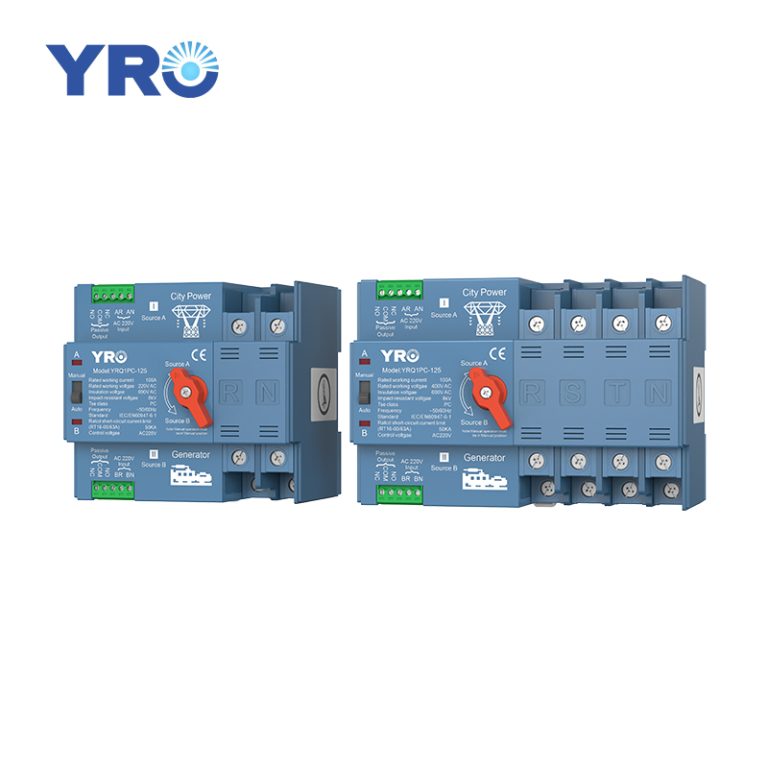
When an EV charging station loses grid power, drivers still expect the stall to keep working, and a microgrid expects its loads to stay balanced. A dual power transfer switch is the device that makes that possible by moving your site between the main supply and a backup source the moment the primary feed fails. In this guide we explain how transfer switches operate, where they fit in EV and microgrid projects, and which specifications you should check before procurement. You will also see where YRO’s transfer switch range lines up with common project requirements.
What Is a Dual Power Transfer Switch?
A dual power transfer switch is a switching device that sits between two available power sources and a single load. Its only job is to connect the load to one source at a time. Most units monitor the main supply for voltage, frequency, or phase faults. When the main feed falls outside tolerance, the switch moves the load to the backup source. When the main supply returns and stabilizes, the switch can move the load back automatically or hold until an operator confirms it is safe.

It is important to be precise about what this device is not. A dual power transfer switch does not generate electricity. The backup source, whether a generator, a battery energy storage system, or another grid connection, must be provided by your system design. The switch only decides which source feeds the load, and it does so without letting the two sources bridge in a way that creates backfeed.
How Transfer Switches Support EV Charging Stations
An EV charging site carries several kinds of load, and they do not all need the same level of backup. The charger power modules, the site controller, the lighting, the payment terminal, and the HVAC each have a different tolerance for interruption. A well-designed backup scheme uses a transfer switch to keep the loads that matter most, such as the control system, safety lighting, and part of the AC charging bank, running from the backup source during an outage.
You should plan the transfer carefully rather than assume every stall stays live. Most transfer switches use a break-before-make sequence, which means there is a brief interruption while the connection moves from one source to the other. For DC fast charging, that break can drop an active charging session unless the charger and the backup source are coordinated for seamless handover. A Notstromübertragungsschalter sized and placed for your critical loads gives you a predictable, code-aware path to keep the site operating through a grid event.
Dual Power Transfer Switches in Microgrid Systems
A microgrid can draw from more than one source: the utility grid, a standby generator, a photovoltaic array with storage, or even a fuel cell. In a specific microgrid architecture, the transfer switch plays a defined role, such as moving the shared bus between grid-connected mode and islanded mode, or shifting between the generator and the storage inverter when the grid is unavailable.
You should not assume that an ordinary automatic transfer switch can support every microgrid out of the box. The right design depends on source synchronization, load characteristics, and the switch’s own rating. If two sources must run in parallel or the bus must stay energized with no break, the switch needs to match those conditions, and the microgrid controller must coordinate the sequence. For solar-linked sites, a PV automatic transfer switch built for inverter-to-grid changeover is a more direct fit than a generic unit.
Automatic vs. Manual Dual Power Transfer Switches
The main difference is who initiates the transfer. An automatic transfer switch (ATS) senses the fault and moves the load on its own, usually within seconds, which suits unattended sites such as public charging hubs and islanded microgrids. A manual transfer switch (MTS) requires an operator to move the handle, which keeps cost down and fits staffed locations where someone can respond to an outage.
Your selection should follow criticality and attendance. If the load cannot tolerate a long interruption and no one is on site, an automatischer Umschalter is the safer choice. If the site is staffed and the backup is for convenience rather than strict continuity, a manual transfer switch can meet the need at a lower price, with some models adding remote control so the operator does not need to be at the panel.
How to Choose the Right Dual Power Transfer Switch
Matching the device to your project starts with the electrical basics and ends with the details of your source setup. Check these points before you request a quotation:
- Rated voltage and poles – confirm the switch matches your system voltage and whether you need 2-pole, 3-pole, or 4-pole switching for the neutral.
- Nennstrom – size the switch for the continuous load plus a margin; do not size to the breaker trip alone.
- Transfer type – open transition is simpler and lower cost; closed transition avoids the break if your load demands it.
- Schaltzeit – faster transfer suits sensitive loads; match it to what your charger or controller can accept.
- Source and load profile – note whether the backup is a generator, storage, or PV inverter, and whether the load is resistive or motor-driven.
- Enclosure and certification – verify IP rating for the location and the marks your market requires, such as CE, TUV, or RoHS.
| Your project need | Recommended starting point |
|---|---|
| Mostly unattended EV hub or microgrid | Automatic transfer switch (ATS) |
| Staffed site, cost-sensitive | Manual transfer switch (MTS) |
| Grid plus PV or storage islanding | ATS rated for the source configuration |
| Sensitive load, no break allowed | Closed-transition ATS option |
YRO builds both ATS and MTS units for low-voltage applications, with models such as the YRQ4PC-63 series at 63 A and fast-transfer options around 30 ms for solar and storage-linked sites. Each unit is backed by in-house type testing and carries CE, TUV, and RoHS compliance, which helps you meet tender and import requirements in most markets.

Specify the Right Transfer Switch for Your Site
YRO designs automatic and manual dual power transfer switches for EV charging and microgrid applications, with CE, TUV, and RoHS compliance plus in-house type testing. Share your single-line diagram and load profile, and our engineers will match a model to your voltage, current, and transfer-time needs.
Frequently Asked Questions
What transfer time can I expect from an automatic transfer switch, and why does it matter for EV chargers?
Typical ATS transfer times range from a few seconds down to tens of milliseconds for fast models. The break matters because an active DC fast-charging session can drop during the switch-over. You should match the transfer time to what your charger and site controller can ride through, and keep the most interruption-sensitive loads on a coordinated backup path.
Can a dual power transfer switch work with a solar battery storage system as the backup source?
Yes, provided the storage inverter and the switch are specified for the handover. The transfer switch moves the load between the grid and the storage output, but the storage system must be able to form or sync to the bus as required. Confirm the source type and synchronization condition with the manufacturer before you commit the design.
Do EV charging stations legally require a transfer switch for backup power?
There is no single global rule that forces a transfer switch on every site. Requirements depend on local electrical code, the site’s emergency-load obligations, and whether the backup source can ever touch the utility feed. A transfer switch is the standard safe way to separate sources and prevent backfeed, which most codes treat as mandatory wherever a backup source exists.
What is the difference between open-transition and closed-transition transfer?
Open transition breaks the connection to the first source before making the second, which is simpler and lower cost but causes a brief power gap. Closed transition overlaps the two sources for a moment so the load sees no break, which suits sensitive equipment but needs both sources to be synchronizable. Your load tolerance decides which to specify.
How do I size the current rating of a transfer switch for a fast DC charger?
Start from the charger’s continuous input current, not its peak. Add the other backup-supported loads on the same bus, apply a service margin, and confirm the switch rating at your system voltage. If several chargers share one backup feeder, size the switch for the combined load rather than a single unit.
Can I retrofit a transfer switch into an existing EV charging site without downtime?
Often yes, but it depends on how the site is wired. A bypass or isolation arrangement lets you install or maintain the switch while the load stays fed. You should review the existing single-line diagram with the manufacturer, because some retrofits need a planned window even with a bypass path.
What maintenance does a dual power transfer switch need to stay reliable?
Plan periodic functional tests of the source-sensing and transfer action, inspect contacts for wear, and verify torque on connections. Many sites run a scheduled exercise with the backup source so the mechanism does not sit idle. Keep a log, because tender and warranty reviews often ask for it.
Is a manual transfer switch safe for a commercial EV charging station?
It can be safe where a trained operator is present and the backup is for convenience rather than strict continuity. For unattended public hubs, an automatic transfer switch is the stronger choice because it acts without anyone on site. Either way, the switch must be rated and installed to prevent backfeed to the utility.
How does a transfer switch interact with a microgrid controller or energy management system?
The controller usually decides when to island or reconnect, and the transfer switch executes the physical move. They communicate through dry contacts or a control signal so the sequence is coordinated. You should confirm the switch’s control inputs and timing match the controller’s logic before commissioning.
What certifications should I look for when sourcing transfer switches from a manufacturer?
Look for the marks your market accepts, commonly CE for Europe, with TUV and RoHS as strong supporting evidence of safety and material compliance. ISO 9001 at the factory points to consistent production control. Ask the supplier for test reports tied to the exact model you plan to buy, not a general catalog claim.
Related Resources
If you are comparing switch types or planning a procurement, these YRO guides go deeper on the topics above:
- Open Transition vs. Closed Transition ATS: Which Is Better for Your Facility?
- Service Entrance Rated vs. Non-Service Entrance Rated ATS
- Bypass Isolation Transfer Switches: Why Data Centers and Hospitals Need Them
- 7 Key Features to Look for When Buying a Solar Transfer Switch
- 5 häufige Gründe, warum Ihr automatischer Übertragungsschalter nicht umschalten konnte
Choosing the right dual power transfer switch comes down to matching the device to your source configuration, load profile, and how much downtime your EV charging or microgrid site can tolerate. YRO designs ATS and MTS units rated for demanding environments, with CE, TUV, and RoHS compliance and in-house testing to back each specification. If you are scoping a new station or retrofitting backup power into an existing microgrid, our engineering team can review your single-line diagram and recommend a matched model. Reach out for a quotation tailored to your project’s voltage, current, and transfer-time requirements.