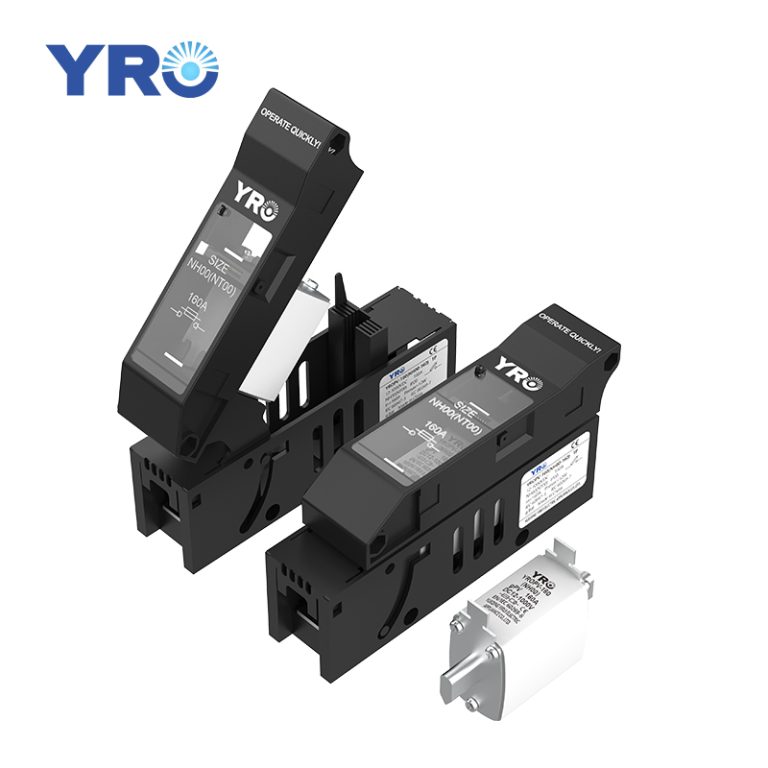







When the fusible operates, what roles do voltage and current play respectively? Why is focusing only on current insufficient for a complete understanding of safety? This article aims to help you better understand these two concepts.
The Role of Current in a Fuse
When an overload or short circuit occurs in a circuit, the current flowing through the fuse link increases dramatically. According to Joule’s law (Q = I²Rt), the larger the current, the more heat is generated, causing the fuse element’s temperature to rise faster, leading to it blowing.
From this, we can understand that the “blowing” of a fuse is essentially caused by the heat generated by the current.
The speed of blowing depends on the magnitude of the current and the design of the fuse. Some fuses are fast-acting types, designed for sensitive electronic equipment to respond quickly to slight overcurrents; while other fuses are slow-blow or time-delay types, capable of withstanding momentary inrush currents without nuisance blowing. Generally speaking, the larger the current, the shorter the blowing time.
Because the overcurrent mechanism is relatively predictable, the performance of a fuse can be understood through time-current characteristic curves. Engineers use these curves to determine how long a fuse can operate safely under different multiples of overcurrent, providing reference and assistance for electrical design.

What is the Arc Extinguishing Process of a Fuse?
As shown in the diagram below, we can see that the surrounding area of the fuse core is filled with fine sand. The purpose of this is to extinguish the arc.
The copper plate of the fuse core is punched with a notch and coated with tin beads. When the temperature reaches the melting point of tin, tin melts first and forms an alloy with copper. The melting point of the alloy is much lower than that of copper, so the fuse will melt at the notch. This method is called the metallurgical effect, and it can relatively accurately determine the melting current value of the fuse.
The metallurgical effect is widely used in the design and manufacture of fuses. When a short-circuit current flows through the fuse, the arc at the notch will extinguish. Then, the fine sand flows into the break, forcing the arc to be cooled and extinguished, and the fuse thus completes the task of breaking the circuit.

Does Voltage Affect the Fuse?
Although current is the primary factor, the influence of voltage cannot be ignored.
Fuses have a specific rated voltage. When the circuit voltage exceeds the fuse’s rating, the extinction of the arc after the element melts is affected. If the voltage is too high, the fuse may not be able to interrupt the circuit correctly, causing the arc to persist and potentially damaging the equipment. In DC circuits, the effect of voltage on the interruption speed is particularly significant, because a DC arc is more difficult to suppress than an AC arc.
That is to say:
- Current determines whether the fuse will begin to blow;
- Voltage determines whether the fuse can successfully and safely interrupt the circuit after blowing, preventing the fault from escalating.
Conclusión
Overall, the direct cause of a fuse blowing is the thermal effect of the current. When the current exceeds a certain range, the temperature of the fuse element keeps rising until it reaches the melting point and cuts off the circuit. However, this does not mean that voltage has no role throughout the process. Voltage mainly affects the formation and extinction of the arc after the fuse blows, as well as whether the fuse can reliably complete the circuit break.
Therefore, from the perspective of the heating of the fuse element, the fuse blowing is mainly determined by the current; while from the perspective of whether the circuit can be safely cut off, voltage is also an indispensable condition. Only when both the current and voltage parameters are within a reasonable range can the fuse play a stable and reliable role in circuit protection.