





If you find that the solar panels on the roof suddenly catch fire, your first reaction might be to immediately unplug the power cord to cut off the power supply. This idea sounds reasonable, but in reality, it involves significant risks.
When a fire breaks out, manually disconnecting the power supply of the solar energy system not only fails to effectively control the fire situation, but may also increase the risk of electric shock, generate direct current arc flashover, and even accelerate the spread of the fire. Next, we will explain why “unplugging” can be a very dangerous behavior and what correct measures should be taken.

Why Unplugging Isn’t the Solution?
1. The Live State Still Exists
Unlike household appliances that power off when unplugged, solar panels continue to generate current as long as they are exposed to sunlight, regardless of whether they are connected to electrical equipment. Even under cloudy or smoky weather conditions, solar modules still have voltage output.
If you unplug the system while it is live, you are essentially forcibly cutting off the circuit, which will generate a strong electric arc at that moment. The temperature of this arc can exceed 3000°C, easily causing secondary electric shocks or igniting surrounding combustible materials.

2. Energy Storage Components Still Retain Electrical Energy
Inverters and other devices have capacitors or inductors for energy storage inside. Even after power failure, they will still release high voltage for a short period of time. Unplugging the plug directly cannot cut off these energy storage circuits and still poses an electric shock risk.
3. Bypassing Safety Protection Devices
When directly unplugged, the system does not go through the arc extinguishing process of the circuit breaker, nor does it have the overcurrent cutoff of the fuse. This causes the current to form a parallel arc in the instantaneous circuit, making it difficult to extinguish quickly.
How Does RSD Change the Situation?
Modern fire protection regulations and electrical standards of some countries require photovoltaic systems to be equipped with rapid shutdown devices, which are precisely designed to address the safety risks mentioned earlier.
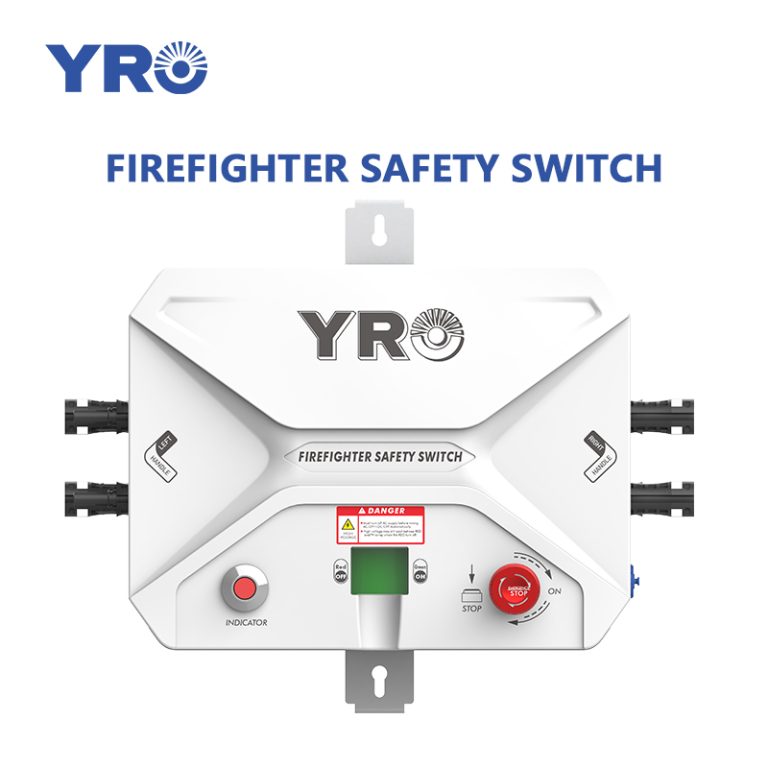
Unlike manual plugging and unplugging operations, RSD can reduce the output voltage of solar panels through automatic triggering or remote manual control, thereby providing a safe operating environment for rescue personnel.
YRO Rapid Shutdown Switch
YRO’s rapid shutdown switch features fast response speed and protection ratings of IP66 and IP68. It is suitable for solar systems up to 1500V and can achieve second-level safety shutdown in emergency situations.
YRO has over 10 years of experience in the electrical and new energy industries, operating as an integrated manufacturer combining production and sales, providing OEM and ODM customization services. Their products are widely used in photovoltaic power generation and distribution systems.

Emergency Steps After Solar Panels Catch Fire
- Cut off the main power supply: First, turn off the main power supply to ensure that the system is completely de-energized.
- Use appropriate fire extinguishing equipment: such as dry powder or carbon dioxide fire extinguishers. Do not use water to put out the fire to avoid conducting electricity and causing electric shock.
- Keep a safe distance and call the police: After ensuring safety, immediately dial the fire department and have professional firefighters and electrical maintenance personnel handle the situation.
Conclusion
When a fire breaks out in a solar panel, directly unplugging the plug not only fails to effectively avoid danger but may also accelerate the spread of the fire.
Solar energy systems carry certain fire risks, such as high voltage on the DC side, hot spot effect, arc problems, and accumulation of flammable materials in the surrounding area. Therefore, the installation of the system must comply with professional standards, which is the foundation for ensuring safety. In addition, regular professional inspections and maintenance are equally important.
As long as the design, installation, daily maintenance and emergency preparedness are all standardized and in place, solar energy can be better utilized and the cleanliness and convenience it brings can be enjoyed.