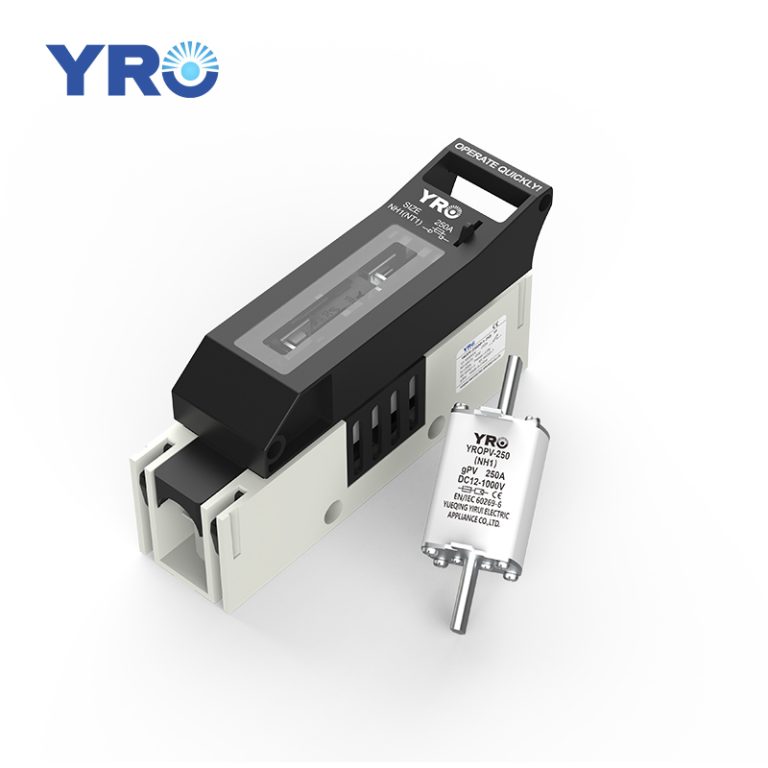






In the modern field of power distribution, circuit protection is confronted with an increasing number of complex situations. Although เบรกเกอร์วงจร, solid-state devices and electronic protection relays have been widely used, low-voltage fuses still play an important role in many systems. This article will explore why fuses are still widely used in low-voltage systems, against the backdrop of the continuous development of various alternative technologies.
Advantages of Fuses in Circuit Protection
- Rapid Action Protection: When the current exceeds the rated value, the ฟิวส์ element quickly melts due to overheating, thereby interrupting the circuit before the short-circuit current fully develops, providing effective current limiting. Compared to circuit breakers, fuses perform better in terms of current limiting.
- Simple Structure: Fuses have no moving parts, only a fuse element, contacts, and housing, avoiding failures caused by mechanical wear, dust, oil stains, or corrosion.
- Low Cost: The cost of a single fuse is much lower than that of a low-voltage circuit breaker. Especially in distribution networks, where hundreds or even thousands of end circuits need protection, using fuses can significantly reduce the overall investment.
- Flexible Coordination: Fuses can coordinate with circuit breakers, relays, etc., to achieve selective protection.

Scenarios Where Fuses Are Superior to Other Protective Devices
- Short-Circuit Protection Requiring Very High Breaking Capacity
Fuses can respond within milliseconds, interrupting the circuit before the fault current forms an arc, thereby reducing the impact on subsequent equipment. This characteristic makes fuses suitable for applications with high short-circuit currents, such as distribution busbars, the low-voltage side of transformers, and large motor starting circuits.
- DC Side Protection
The short-circuit current in DC circuits of UPS, photovoltaic inverters, energy storage systems, and charging piles often cannot be reliably interrupted by traditional circuit breakers. Fuses, with their fast melting and high breaking capacity, become the preferred choice.
- Cost-Sensitive, Numerous End Distribution Branches
The low-voltage fuses widely used in residential, commercial buildings, and small industrial distribution boxes have a simple structure and low unit cost, enabling reliable overload/short-circuit protection with minimal investment.
- Harsh Environments
Fuses do not rely on mechanical moving parts, are resistant to vibration and corrosion, and are suitable for distribution systems in coastal, mountainous, or high-altitude areas, maintaining long-term stable protection performance.

How to Choose the Right Low-Voltage Fuse for Your Electrical Equipment?
- แรงดันไฟฟ้าที่ได้รับการจัดอันดับ: The fuse must match the maximum operating voltage of the circuit.
- Rated operating current (In) : The maximum continuous current of the circuit during normal operation.
- Short-circuit breaking capacity (Icu): The maximum short-circuit current that can be safely cut off.
- จัดอันดับความสามารถในการทำลาย: The maximum fault current value (Isc) that can be safely disconnected when a short circuit occurs in the circuit, taken as Icu ≥ 25 * Isc
- Temperature: High temperatures will reduce the current-carrying capacity of the fuse. If the fuse is installed in a closed box with a high ambient temperature, it is necessary to consider derating or select a model with a slightly larger rated current.
บทสรุป
Despite the continuous emergence of modern protective equipment, low-voltage fuses are still widely used in many power systems. Its main advantages lie in its rapid action, strong breaking capacity, compact structure and low cost. Therefore, it is of great value in situations where selective protection is required, as a backup protection, or where installation space is limited. By making reasonable selections, cooperating well with other equipment in the line, and following installation and maintenance norms, engineers can effectively enhance the reliability and safety of low-voltage distribution systems by using fuses.