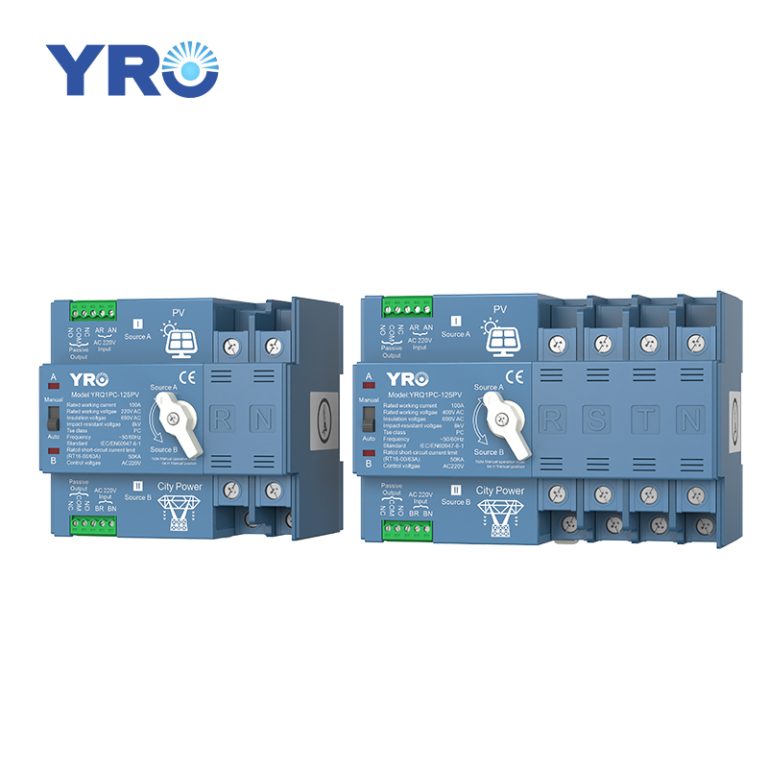






Automatic Transfer Switches (ATS) and Manual Transfer Switches (MTS) are essential devices in electrical systems for power source switching. They each have unique operating principles, application scenarios, and technical advantages. Understanding their differences is key to choosing the right device for specific applications.
What Are the Advantages of Changeover Switches?
1,The Advantages of Automatic Transfer Switch (ATS)
1.1 High Efficiency and Immediacy
The core advantage of ATS lies in its high efficiency Và immediacy. When the main power supply fails, ATS can quickly detect the fault and immediately switch to the backup power supply, ensuring the sự liên tục của việc cung cấp điện. This process is usually completed within seconds, avoiding the impact of power interruptions on equipment and business operations. In contrast, MTS requires manual switching, which is not only time consuming but also may result in operational delays hoặc errors due to human factors.
1.2 Reliability and Stability
các độ tin cậy Và sự ổn định of ATS are significant advantages. ATS usually adopts advanced electronic control systems and precise mechanical mechanisms to maintain stable performance under harsh environmental conditions. The switching mechanism of ATS is precisely designed to minimize the risk of failure, due to improper operation hoặc aging equipment. In comparison, the reliability of MTS depends more on the skills Và experience of the operators, as well as the maintenance Và upkeep of the equipment.
1.3 Security and Compliance
các automation Và độ tin cậy of ATS help meet stringent compliance Và security requirements in scenarios where power supply is critical, such as bệnh viện, trung tâm dữ liệu, Và nhà máy. ATS protects the continuity of business critical operations, và security of data by enabling fast power switching and reducing the impact of power interruptions. Furthermore, ATS typically complies with standards such as the International Electrotechnical Commission (IEC) và U.S. National Electrical Code (NEC), ensuring global safety and compliance.

2、The Advantages of Manual Transfer Switch (MTS)
2.1 Lower Cost
Compared with ATS, MTS features a relatively simple structure and more basic functions. As a result, the cost of MTS is significantly lower, making it suitable for places with a limited budget or low demand for chuyển đổi nguồn điện. Particularly in environments where frequent switching is unnecessary, MTS provides sufficient power management capabilities without incurring the high expense of ATS.
2.2 Easy Operation
Although MTS requires manual operation, its design is typically very simple, allowing users to easily perform chuyển đổi nguồn điện. For smaller power systems, manual switching is often sufficient to meet the requirements without the need for complex automation.
2.3 Suitable for Low Load Requirements
MTS is an excellent choice for systems with lighter loads and a higher tolerance for power outages. It does not require complex control systems hoặc sensors, making it ideal for systems that do not need fast switching hoặc automated management.
2.4 Wide Applicability
MTS is widely used in scenarios where độ tin cậy cao Và rapid switching are not essential. For example, in homes, offices, and some small factories, where there is a greater tolerance for power interruptions, MTS can meet the basic requirements without the need for additional investments.
How to Choose Between ATS and MTS Based on Different Application Scenarios?
When selecting between an atự động tsự đòi tiền chuộc switch and a manual tsự đòi tiền chuộc switch several factors should be taken into account, including switching speed, cost, Và maintenance requirements. Below, we discuss how to choose the right device based on different application scenarios.
1. Critical Business Scenarios
For scenarios requiring độ tin cậy cao Và continuous power supply, chẳng hạn như bệnh viện, trung tâm dữ liệu, financial hubs, Và transportation hubs, ATS is the preferred choice.
In these environments, power outages can result in severe personal harm, financial losses, Và reputational damage. The automation, độ tin cậy, Và intelligent features of ATS ensure the stability and continuity of the power supply. This safeguards the operation of critical services and protects sensitive data integrity.
2. Non Critical Business Scenarios
Vì non critical business environments, chẳng hạn như small offices, retail stores, Và residential properties, MTS may be a more suitable option.
In these scenarios, power interruptions, while inconvenient, typically do not lead to severe consequences. Additionally, MTS offers a lower cost solution Và simpler operation, making it ideal for use cases with budget constraints or limited operations and maintenance capabilities.
By understanding the specific requirements of the application and evaluating the trade offs between cost, reliability, and operational complexity, businesses and individuals can make an informed decision between ATS and MTS.
3. Temporary power solutions
ATS Và MTS each have specific applications for temporary power solutions, chẳng hạn như construction sites, event venues, Và emergency response situations.
Vì temporary power solutions requiring rapid deployment Và flexible switching, ATS is often the better choice. Its automation Và độ tin cậy ensure the continuity Và sự ổn định of the power supply, meeting the demands of dynamic environments.
Vì simple temporary power needs, MTS may be a more economical Và practical solution, as it provides basic functionality at a lower cost.
4. Cost budget and O&M capability
When choosing ATS hoặc MTS, you also need to consider the cost budget and O&M capability; ATS usually costs more than MTS, but its automation and intelligent features can reduce O&M costs and improve O&M efficiency. If the cost budget is limited or the O&M capability is weak, MTS can be chosen as an alternative. However, it should be noted that the O&M cost of MTS may increase due to the uncertainty caused by human factors.
In conclusion, both ATS and MTS have their own advantages and disadvantages. The choice of device depends on the application environment and actual needs. ATS is suitable for high load environments with critical power supply requirements and high automation needs, such as trung tâm dữ liệu Và bệnh viện, where power interruptions are highly sensitive. On the other hand, MTS is more suitable for environments with lighter loads and lower power switching requirements, such as residential buildings Và small commercial buildings. When selecting the appropriate device, it is important to consider factors such as response speed, cost, ease of operation, Và maintenance requirements to ensure higher reliability and efficiency for the power system.