





مقدمة
Modern industrial operations depend heavily on continuous and reliable electrical power. Even a brief power interruption can result in production downtime, data loss, equipment damage, and operational safety risks.
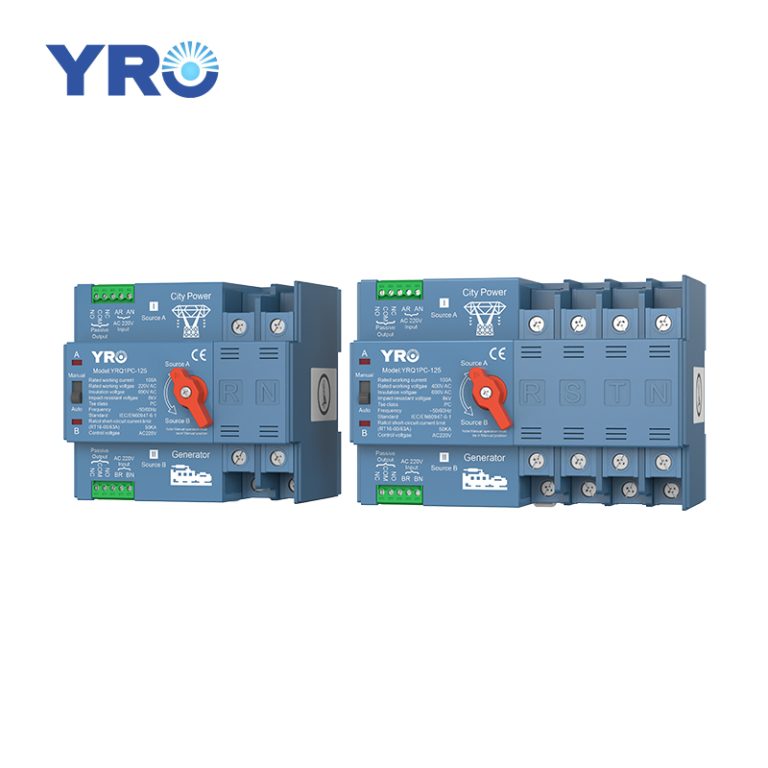
Backup power systems play a critical role in maintaining business continuity. At the center of most backup power architectures is the تبديل النقل, a device responsible for safely switching electrical loads between utility power and generator power.
One of the most important decisions facility engineers and procurement teams must make is whether to use a single-phase transfer switch أو أ three-phase transfer switch.
Understanding the difference between these systems is essential for designing reliable power infrastructure in commercial and industrial environments.

Understanding Single-Phase and Three-Phase Power Systems
What Is Single-Phase Power?
Single-phase power is commonly used in residential and light commercial applications.
It typically operates at:
-
120V AC
-
240V AC
Single-phase systems deliver electricity through one alternating current waveform. While sufficient for low to moderate load environments, single-phase power may experience voltage fluctuations under heavy load conditions.
What Is Three-Phase Power?
Three-phase power is the standard for industrial and high-demand commercial applications.
Three-phase systems use three alternating current waveforms that are offset in phase. This configuration provides several advantages:
-
More stable and continuous power delivery
-
Higher load capacity per conductor
-
Improved efficiency for motor-driven equipment
-
Reduced current imbalance
Three-phase power is commonly found in manufacturing plants, hospitals, data centers, and large commercial buildings.
Typical industrial voltage configurations include:
-
120/208V three-phase
-
240V three-phase
-
277/480V three-phase
-
600V systems in certain applications
What Is a Transfer Switch?
A تبديل النقل is an electrical switching device positioned between the utility supply and backup generator system.
Its primary function is to ensure:
-
Only one power source is connected to the load at any time
-
Backfeed to utility lines is prevented
-
Automatic or manual switching can be executed safely
Most industrial facilities now prefer automatic transfer switches (ATS) for critical operations.
The fundamental operating principle is break-before-make switching, which ensures electrical isolation before connecting to an alternate power source.
Single-Phase Transfer Switch: Design and Applications
Single-phase transfer switches are generally used in lower power environments.
Electrical Configuration
-
Typically 2-pole or 3-pole switching structures
-
Supports 120V or 240V circuits
Typical Applications
-
Small offices
-
Retail facilities
-
Residential backup systems
-
Light commercial equipment
Limitations in Industrial Use
Single-phase transfer switches may not be suitable for facilities that operate:
-
Large motors
-
Industrial HVAC systems
-
High-capacity processing equipment
Three-Phase Transfer Switch: Industrial Design Requirements
Three-phase transfer switches are engineered for higher electrical complexity.
Phase Configuration
Industrial three-phase transfer switches may be designed as:
-
3-pole switching systems – neutral remains continuously connected
-
4-pole switching systems – neutral is switched during transfer
The selection depends on grounding architecture and local electrical design requirements.
Voltage Rating Considerations
Industrial ATS units are commonly rated for:
-
208V systems
-
480V systems
-
600V heavy-duty environments
Voltage matching between utility, generator, and transfer switch is critical for safety.
Phase Monitoring and Utility Loss Detection
Advanced three-phase transfer switches include phase monitoring technology.
The system continuously evaluates:
-
Phase A voltage
-
Phase B voltage
-
Phase C voltage
If any phase experiences voltage loss, the system interprets it as a power failure and initiates generator startup and transfer sequence.
Load Capacity
Three-phase transfer switches are commonly available in ranges from:
-
100A industrial models
-
400A commercial systems
-
800A+ high-capacity installations
-
Multi-thousand amp custom solutions
Motor-driven equipment requires special attention because startup currents can be several times normal operating current.
Single-Phase vs Three-Phase Transfer Switch Comparison
| ميزة | Single-Phase | Three-Phase |
|---|---|---|
| Voltage Levels | 120V / 240V | 208V / 480V / 600V |
| البولنديين | 2–3 | 3–4 |
| Load Capacity | Lower | عالي |
| Phase Monitoring | Not required | Required |
| Typical Application | Residential, light commercial | Industrial, data centers |
| System Complexity | Lower | Higher |
How to Choose the Correct Transfer Switch for Your Facility
Facility engineers should evaluate the following factors:
Electrical Service Type
Confirm whether the site operates single-phase or three-phase utility service.
Generator Output Compatibility
Backup generators must match the transfer switch voltage and phase configuration.
Load Profile Analysis
Industrial facilities should account for:
-
Continuous operating load
-
Motor startup surge currents
-
Future expansion requirements
Code Compliance and Safety Standards
Local electrical regulations may influence pole configuration and grounding methods.
Common Selection Mistakes in Industrial Transfer Switch Design
Typical engineering errors include:
-
Installing single-phase switches in three-phase facilities
-
Undersizing current ratings
-
Ignoring phase imbalance protection
-
Incorrect neutral switching configuration
-
Failure to consider future load expansion
Proper system design helps avoid costly downtime and equipment damage.
خاتمة
Selecting the right transfer switch is a fundamental decision for any industrial or commercial power system.
Single-phase transfer switches are suitable for light load environments, while three-phase transfer switches are the standard solution for modern industrial facilities requiring stable, high-capacity power distribution.
For factories, data centers, hospitals, and large commercial buildings, three-phase transfer switches provide superior reliability, efficiency, and operational safety.
If you are planning a new backup power project or upgrading an existing electrical infrastructure, choosing the correct transfer switch early in the design stage is essential.
As a professional الشركة المصنعة لمفتاح النقل, we welcome inquiries from industrial buyers, system integrators, and equipment distributors.
Our engineering team can help evaluate your electrical configuration, load requirements, and installation constraints to recommend the most suitable solution.
Contact our technical team today to discuss your transfer switch requirements and receive professional system guidance.