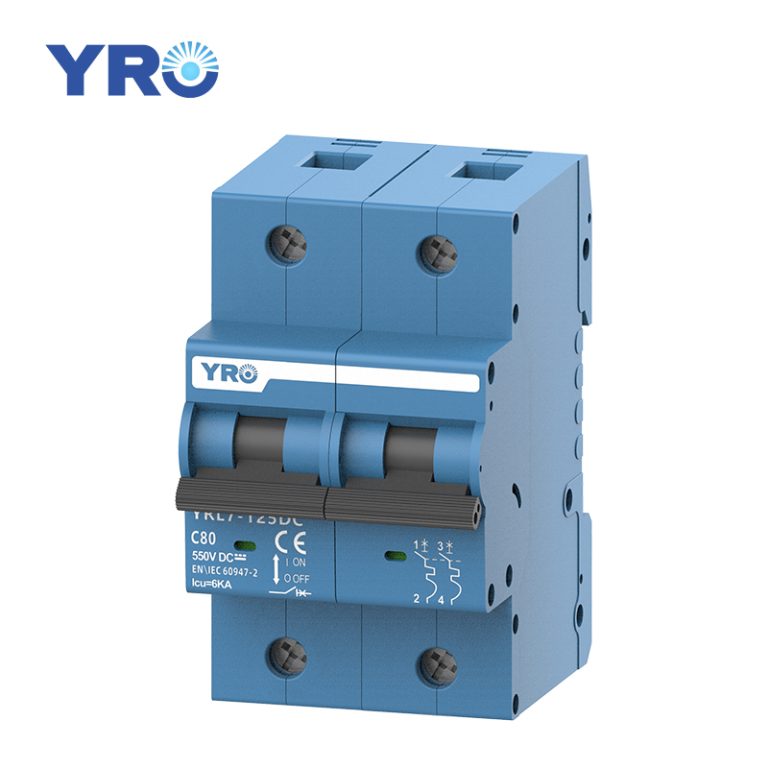






When homeowners notice a sudden spike in their monthly electricity bill, they often suspect that someone is stealing electricity. But they might not expect that a faulty circuit breaker can also increase the electricity bill. Although a damaged disjoncteur usually does not directly consume electricity like appliances do, in some cases, it can indirectly cause an increase in electricity consumption.
The Breaker Itself Consumes Almost No Power
Le standard miniature circuit breaker in a home distribution panel is essentially a passive device during normal operation. It does not actively consume electricity like an air conditioner, water heater, or motor, nor does it continuously consume noticeable power. Therefore, a normally functioning circuit breaker usually does not make the electric bill higher.
In the closed state, the contact resistance inside the disjoncteur is very low, and the electrical energy loss generated is typically minimal. For a common 15-amp or 20-amp residential circuit breaker, even during long-term operation, this loss is usually low enough to have almost no noticeable impact on the household electric bill.
Even if the internal contacts of the circuit breaker have slight wear, their resistance generally does not increase to a level that would significantly change the total household electricity consumption. Circuit breaker contacts are typically made of silver alloy or copper alloy materials, inherently designed to maintain low resistance and stable conductive performance.
When a circuit breaker truly malfunctions, the more common situations are usually nuisance tripping, failure to reset properly, or unstable power supply. These situations generally do not directly make the meter spin noticeably faster, nor do they become the main cause of a sudden increase in the electric bill.
Of course, if the circuit breaker is severely aged and the internal contact is noticeably poor, it could theoretically produce a small amount of additional electrical energy loss. But in the vast majority of household scenarios, this loss is usually quite limited and often insufficient for the user to notice clearly on the electric bill.

Where the Power Waste Really Happens
The real connection between a faulty electrical disjoncteur and a high bill lies in the secondary effect. Frequent tripping of the circuit breaker may indicate an overload in the circuit, but the circuit breaker itself is not an energy waster. The following conditions that often occur simultaneously with a faulty circuit breaker may increase your electricity bill:
Loose or Corroded Terminal Connections on the Electrical Disjoncteur
When the screw terminal securing the wire becomes loose, the contact pressure drops, and the contact resistance may increase. Current still flows, but the higher resistance causes some electrical energy to dissipate as heat instead of being effectively used by the equipment. This is real energy loss.
For example, if a loose connection point produces about 0.1 ohm of additional resistance and carries 10 amps of current long-term, according to P=I²R, that connection point will continuously generate about 10 watts of heat. If this load continues all day, it could theoretically consume roughly an additional 7.2 kilowatt-hours of electricity per month.
However, in most residential scenarios, the load is usually not constant all day, so the actual loss is often even lower. Compared to the increase in the electric bill, what is more concerning is that long-term heating may lead to insulation aging, terminal damage, and even an increased fire risk.
Electricians usually discover such problems by using thermal imaging to detect localized hot spots, or by measuring the voltage drop across the connection point. The energy loss is real, but in most cases it is localized loss, not the primary cause of a significant rise in the electric bill.
Unstable Voltage Damages Appliances
If the internal contact of the low voltage disjoncteur is not good, the current will become unstable when passing through. At this time, the connected appliances may experience a short-term voltage drop.
Some appliances, especially those with motors, such as refrigerators, air conditioners, or water pumps, will “work harder” when the voltage is insufficient. To maintain normal operation, they sometimes consume more current and even have a reduced efficiency.
For a simple example:
If the power supply to the refrigerator is unstable, it will take longer to reach the cooling effect. Although the increase in power consumption is not necessarily large each time, over time, the electricity bill will gradually be affected.
However, this situation is not common, and it also requires several conditions to be met:
- The circuit breaker is just a “poor contact” fault, rather than a direct tripping failure
- It is connected to frequently operating high-power appliances
- The problem persists for a long time
So, for most households with a sudden increase in the electric bill, the true cause is usually still an aging air conditioner, an abnormal water heater, a faulty refrigerator, or simply longer usage times, not the circuit breaker itself.
Here is a very important distinction:
The circuit breaker itself does not actively increase electricity consumption. What truly wastes electricity is usually the heating caused by poor contact, the drop in appliance operating efficiency, or the equipment working repeatedly due to abnormal power supply. A bad circuit breaker is more like a “trigger,” not a direct source of power consumption.

The Real Problem Lies Behind the Circuit Breaker
As mentioned earlier, the source of the electric bill increase is not the mini disjoncteur itself. So what is the real cause?
If you find that your electric bill has increased by 20% or more for no apparent reason, it is recommended to start by checking high-power appliances. In a home, the main things to consider are the refrigerator, air conditioner, and water heater; in a factory, it involves more large equipment, such as CNC machines, injection molding machines, and large refrigeration systems.
When such equipment operates abnormally, it often causes the mini MCB to trip frequently. Some users simply replace the circuit breaker without checking the connected equipment, and then find that the electric bill remains high. The reason is actually quite simple: the equipment truly causing the abnormal power consumption is still running continuously.
These devices run for long hours, and the additional energy consumption brought by their declining efficiency gradually accumulates and is reflected in the electric bill.
Conclusion
A faulty power disjoncteur will not directly cause high electricity bills. The power consumed by this device is negligible. However, in some cases, a damaged or unstable circuit breaker may indirectly increase the operating costs of the system through poor contact, frequent restarts, or abnormal power supply.
More importantly:
When there is a problem with the low voltage disjoncteur, it often indicates that there are deeper faults in the power system.
If you notice a sudden increase in electricity bills, along with overheating, frequent tripping, or abnormal noises, then the disjoncteur should be given special attention for inspection.
In the power system, stability and safety are often more important than simply saving on electricity costs.