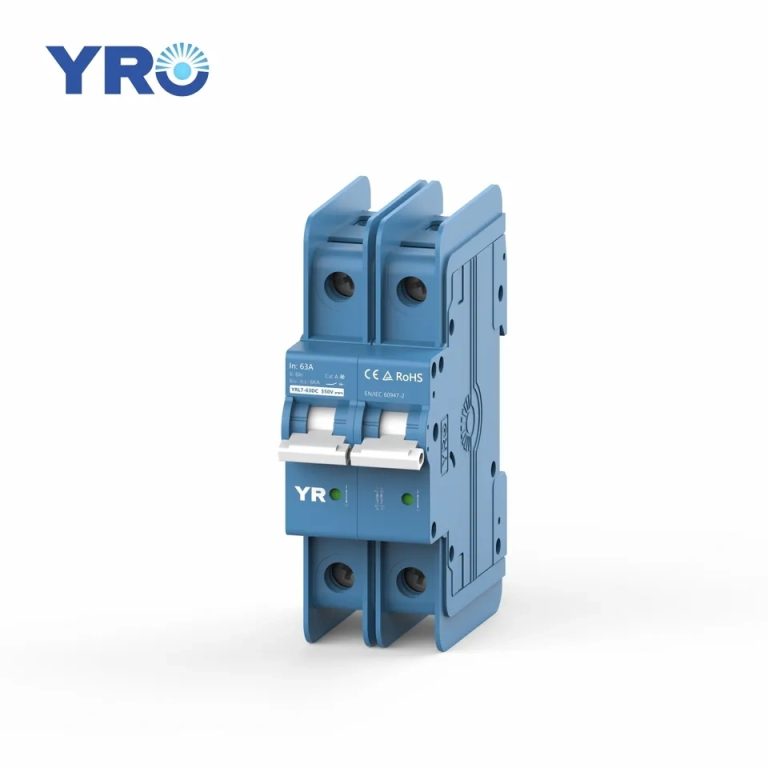






If you have purchased bộ ngắt mạch before, you may have noticed that even products with similar appearances can have significant price variations. This article will mainly discuss the reasons for this price disparity, and explain how choosing the right circuit breaker can affect the safety, lifespan, and overall performance of the system.
1. Internal Materials and Contact Technology
Inside a ngắt mạch, the moment the contacts interrupt the current, extremely high temperatures and arcing occur. The quality of the contact material directly affects the breaker’s lifespan, breaking performance, and price.
Some low-cost products may use contact materials with lower silver content or simpler processing techniques, while high-end products more commonly use silver-nickel, silver-graphite, or other silver-based composite materials. These materials perform more reliably in resisting arc erosion and preventing contact welding, but the raw material cost is also higher.
The bimetallic strip responsible for overload protection similarly affects circuit breaker performance. Higher-quality bimetallic strips undergo more precise processing and calibration, so the tripping action is more stable and accurate, but manufacturing costs also increase.
The material of the electrical ngắt mạch housing also differs. Housings made with glass-fiber-reinforced engineering materials are more stable under high temperatures, arcing, and long-term use, and are less prone to deformation.
2. Certification and Safety Standards
One of the main reasons for the price difference is the certifications held by the circuit breakers. Products certified by recognized standards such as UL or CE require rigorous electrical performance, heat resistance, and safety compliance tests. Manufacturers that go through the certification process usually pass on the costs to customers, which is reflected in higher prices.
Certified circuit breakers can withstand specific tests, such as overload, short circuit, and environmental stress. These tests ensure that the equipment works reliably in normal and abnormal conditions. In contrast, un-certified low voltage bộ ngắt mạch may have lower prices, but they may pose safety risks and may not meet local regulations.

3. Technical Specifications
The technical specifications of a circuit breaker, such as rated current, breaking capacity, and number of poles, directly affect the price. Circuit breakers with higher rated current or stronger breaking capacity require more robust components and precise design.
For example, a 600A molded case circuit breaker (MCCB) used in industrial applications is typically more expensive than a 63A product used in residential settings. This price difference reflects the additional materials, rigorous engineering standards, and testing requirements necessary under high current loads.
4. Supply Chain and Regional Factors
Global supply chain factors also affect the price of thermal magnetic ngắt mạchs. The origin of components, tariffs, transportation costs, and local labor can all influence the final retail price. For instance, a circuit breaker produced in Europe and fully compliant with EU standards is usually priced higher in the Southeast Asian market than similar products produced locally.
5. Additional Protection Features
Basic overcurrent protection is only one part of a circuit breaker’s function. As electrical systems grow more complex, many modern circuit breakers no longer simply handle “tripping to cut power” but instead begin to integrate more protection and monitoring functions.
Some products incorporate ground fault protection, arc fault detection, and leakage protection features to reduce risks arising from wiring aging, insulation damage, or poor connections. Such features require more complex internal structures, including additional sensors, detection coils, control chips, and signal processing circuits, so manufacturing costs increase noticeably.
Compared to traditional electromechanical circuit breakers, products with electronic control modules demand higher component precision and stability. Internally, they must not only continuously monitor current changes, but also quickly identify the fault type, when an abnormal condition arises and complete the tripping action within an extremely short time. This means the product requires greater investment during the research and development, testing, and calibration stages.
Today, some smart circuit breakers also add communication and data monitoring functions, such as remote tripping, energy consumption statistics, fault recording, and operating condition monitoring. These functions require additional PCB boards, communication modules, and supporting software system support.
Beyond the hardware itself, software and firmware development also add to the cost. Smart circuit breakers typically require long-term software maintenance, feature upgrades, and compatibility testing. To ensure the equipment operates stably in different environments, manufacturers also need to conduct extensive electromagnetic compatibility testing and durability testing.

6. Environmental Endurance
Some công nghiệp bộ ngắt mạch are designed for harsh environments. Products with IP protection grades, moisture resistance, extreme temperature resistance, dust resistance, or corrosion resistance will have higher manufacturing costs. Circuit breakers used in outdoor, industrial plants, or coastal high-salt environments are usually more expensive because these additional protections require higher costs.
Phần kết luận
The prices of bộ ngắt mạch vary significantly. Circuit breakers with higher prices usually offer greater reliability, longer service life, and comply with safety regulations. On the other hand, low-priced products may compromise in terms of certification, quality, etc. For any electrical installation, choosing the appropriate circuit breaker not only concerns cost but also safety, compliance, and long-term value.
The correct circuit breaker can ensure the safety and efficiency of the electrical system, and avoid future high maintenance costs or safety hazards.